Registered, filed, and on time
UAE corporate tax registration, annual returns, and the deadlines that carry penalties.
Off-hours — we reply first thing at 9:00 local. Vy is always on.
UAE corporate tax registration, annual returns, and the deadlines that carry penalties.
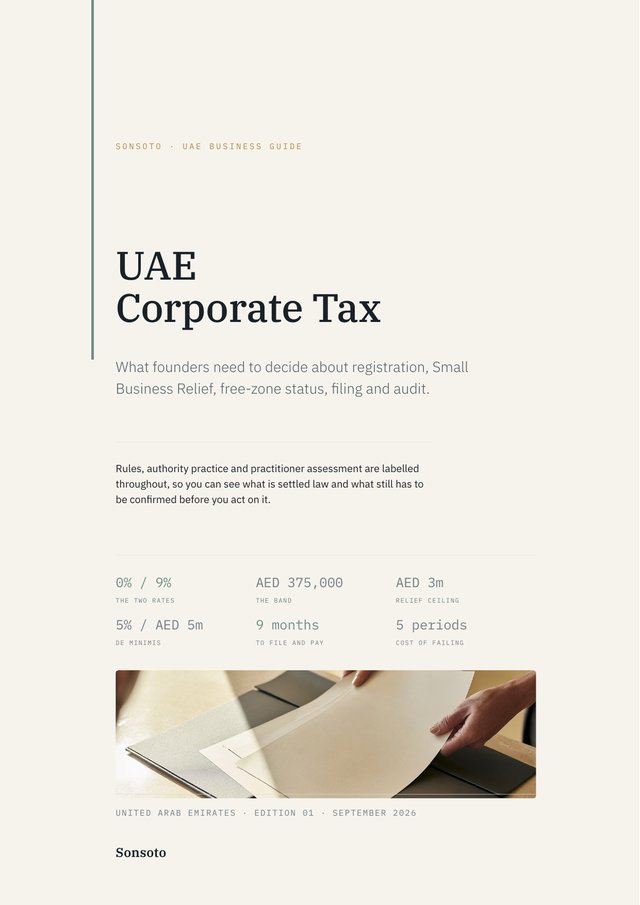
Federal UAE corporate tax applies above the qualifying threshold. Not every business pays it, but many still need to register and file.

Standard 9 percent rate above the taxable threshold, with small-business relief where available.

0 percent may apply to qualifying income if QFZP conditions are met.

Relief may apply below the relevant revenue threshold for the period.

Large groups may also need to consider top-up tax rules.
Registration is separate from payment. Many businesses must register and file even where little or no tax is due.
Required where the corporate tax rules bring the business into scope.
Good accounts matter because filing starts from the numbers.
The tax return follows the relevant financial year.
Returns are due within the statutory deadline after period-end.
Tax is paid by the same deadline, where tax is due.
Related-party rules can apply even where no special rate is claimed.

The 0 percent free-zone rate depends on meeting all QFZP conditions, not just being based in a free zone.

The free-zone business must have real activity and presence in the UAE.

The 0 percent rate applies only to income that stays within the qualifying rules.

Related-party pricing and records still need to hold up.

The entity must meet the audit requirement for the period.

Electing into the standard regime takes the entity out of QFZP treatment.

Non-qualifying income must stay within the permitted limit.
Every filing, deadline, and document — on iOS and Android. The same evidence you see in the console, now portable.
Tell us the entity and turnover. We confirm what you must register for and when.
No obligation. We tell you if it is not the right route.
 Business banking
We assess your business profile, prepare the evidence banks need, and guide you through the right application route.
Business banking
We assess your business profile, prepare the evidence banks need, and guide you through the right application route.
 Corporate tax
UAE corporate tax registration, annual returns, and the deadlines that carry penalties.
Corporate tax
UAE corporate tax registration, annual returns, and the deadlines that carry penalties.
 Renewals & filings
Licence, establishment card, chamber, tenancy, visas and tax returns each renew on their own clock. We put them on one, and run it.
Renewals & filings
Licence, establishment card, chamber, tenancy, visas and tax returns each renew on their own clock. We put them on one, and run it.
 Visas and residence
Every hire is a sequence of government steps. Missing one restarts the clock.
Visas and residence
Every hire is a sequence of government steps. Missing one restarts the clock.

Sonsoto quoted us a line-item budget for the licence, visas and the bank pack up front. Nothing crept in later. That alone was worth the fee.

I’d already been rejected by two banks. Sonsoto told me why, changed the pack, and we opened with WIO in three weeks. Straight answers, no theatre.

They caught a corporate-tax filing we were about to miss and re-scoped the renewals so we stopped paying twice for the same work. Now they run everything.

We’d spoken to four firms and got four different price sheets. Sonsoto was the only one that showed us where the extras came from — and we didn’t need them.

Golden Visa done, family visas done, licence renewed. Same team, same WhatsApp thread. I don’t chase PRO agents anymore.

They told me RAK was a better fit than Dubai for our margin. I’d already paid a deposit somewhere else. They still refunded my Sonsoto retainer and helped me exit.

More clients onboarded, higher payout.
Straight to the account.
More referrals unlocks higher payouts.