

Refer a client. Earn up to VND 38,000,000. Become a referral partner

1-hourGuaranteePreparation & submission

Or your service is free.

Referral Contact WhatsApp
Sign in Start your setup

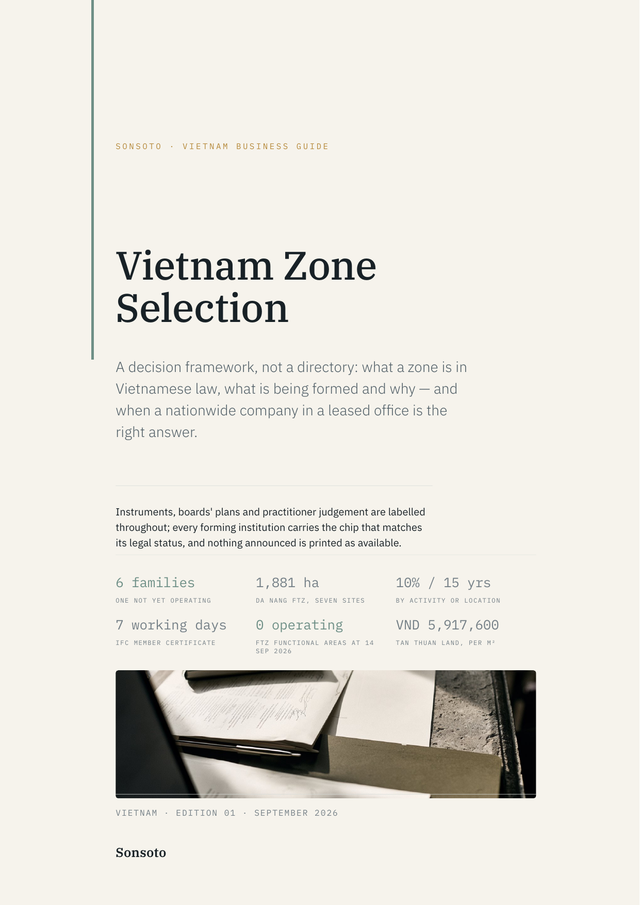
Zone-based entity or city company?

Founders arrive with a Gulf model in mind: a zone as licensing authority, registrar, sponsor and tax status in one. None of that exists in Vietnam. A zone is a place with a management board and a landlord; the company, the tax rate and the permits follow national law inside and outside the fence. Six questions settle the structure.

Investment registrationWhich board issues the certificate
Zone management boardsZone admission & licensing
Enterprise registrationA national company either way
BanksAccount-readiness context

The four things a founder can actually form

Compared on who issues what, where you can sell, premises and exit.

An operator walking through a light-industrial street in a Vietnamese city

Zone-based entity

A company whose project sits in an industrial park, export-processing zone or hi-tech park, with the zone’s board and a sublease from its developer.

A Vietnamese city skyline at first light

City company

A nationwide company registered outside any zone, selling across Vietnam from an office in the city.

A professional writing at a desk with papers

Representative office

A presence, not a business: it cannot invoice or earn income.

Company documents and a pen on a desk

Offshore holding

A foreign holding company owning the Vietnamese company — it changes who owns it, not its tax, customs status or premises.

Six questions settle the structure

Answer them in this order. Each can decide the case on its own, and cost comes last.

How the choice is made

The output is a family of routes, not a single zone — and a shortlist you can check in writing.

  1. 01Discard the headlineOwnership does not need a zone; start from the activity and its conditions.
  2. 02Place the customersExport, domestic or both decides the customs position.
  3. 03Read the incentive from the lawIt follows the activity or the location the law names.
  4. 04Choose the premisesIndustrial land, a fenced site or an office in the city.
  5. 05Shortlist the familyZone family or city company, with the board that would issue the certificate.
  6. 06Compare three yearsThe all-in cost on written quotes, before anything is paid.

The recommendation you get

Before you commit to a site, we send a written shortlist of the routes that are actually viable, with the board that would issue the certificate.

  • A recommended route
  • A shortlist of viable routes
  • The board that would issue the certificate
Example route briefWhat your brief contains
  1. Recommended routeThe structure that fits your activity and customers
  2. Route shortlistOnly the routes that are actually viable
  3. Issuing boardThe board that would issue each route’s certificate
  4. Activity fitWhere your activity sits on the conditional list

Worked cases

Assembling electronics for export, with a domestic tenth

Shortlisted: an export-processing enterprise in a northern park, a hi-tech park and a city company in Ho Chi Minh City.

Business
Electronic modules assembled from imported components
Customers
About nine-tenths shipped to Japan and the EU; a tenth sold to a Vietnamese contract assembler
Needs
About sixty staff in year one and ninety by year three; about 4,000 square metres of factory
Route
An export-processing enterprise in a developer’s park in the north
Fallback
A plain project in the same park, if the assembler will not import
  1. ActivityOpen and not conditional; only the hi-tech park has an admission gate
  2. CustomersThe domestic tenth decides most of what follows; a distributor that imports and resells resolves it
  3. IncentiveThe same rate at every address: it travels with the activity
  4. PremisesA factory needs industrial land or a ready-built workshop, which rules out the city office
  5. LabourNinety people by year three is a northern-park number
  6. CostConfirmed the choice rather than producing it

Deciding whether to wait for the financial centre

A founder building a payments and lending platform asks whether to wait for the International Financial Centre before forming anything in Vietnam.

Business
A payments and lending platform
Membership
Open now to fintech firms that meet the centre’s standards and keep their head office there
Licence
Lending and payments are conditional: the operating licence comes before operating
Route
Form now either way: a nationwide company, or a member entity inside the centre
  1. First questionDoes the firm fit a member category and meet the centre’s standards?
  2. Second questionDoes the product need what the centre offers?
  3. If notForm the nationwide company now: the incentive clock starts with revenue, not with the centre
  4. If soForm the member entity in the centre now: a company formed elsewhere gains nothing by moving

Who lands where.

Banking and capital accounts.

A foreign-owned entity needs a Direct Investment Capital Account before charter capital can be paid in, and the window is 90 days from licensing. We prepare the pack, coordinate with your chosen bank, and track the deadline.


Request a consultation

Zone-based entity or city company?

Tell us the activity, the customers and the premises you need. We send a written shortlist of the routes that are actually viable, with the board that would issue the certificate.

  • A dedicated specialist reviews your case.
  • Fixed scope in writing before any work begins.
  • Avg reply 3 minutes on WhatsApp, 24 × 7.

Request a consultation

No obligation. We tell you if it is not the right route.

Talk to a Vietnam specialist

What clients say

Frequently asked

Does Vietnam have free zones?
Not in the Gulf sense. There is no zone authority that is licensing body, registrar and immigration sponsor in one. Vietnam has industrial parks, export-processing zones, hi-tech parks and economic zones, each with a management board that issues the investment registration certificate and a developer that leases the land, and a national company law, tax law and customs law that apply inside and outside the fence.
Is a hi-tech park a free zone?
No. It is a location on the tax map — the Corporate Income Tax Law names hi-tech parks among the places where a new project gets an incentive rate — and it has its own board and an admission gate for hi-tech activities. It carries no customs status: a project in a hi-tech park gets the non-tariff treatment only if it is separately registered, fenced and confirmed as an export-processing enterprise.
Can an export-processing enterprise sell in Vietnam?
Yes, and each sale is an import. Decree 35/2022 makes trade between an export-processing enterprise and the rest of Vietnam an export-import relationship, lets the enterprise sell into the domestic market, and taxes what it sells as goods imported into Vietnam — customs procedure and import duty on the buyer’s side.
Do I need a zone to own 100% of my company in Vietnam?
No. Full foreign ownership is the default nationwide under the Investment Law 143/2025/QH15, subject to the market-access conditions for foreign investors and the conditional-business list, which is the same list inside and outside every zone. A zone changes which board issues the investment registration certificate; it does not change who may own the company. Since 1 March 2026 a foreign investor may even form the company before applying for the certificate.
Can I move from a zone to the city, or to another zone, later?
Yes, and the company survives the move — the enterprise registration is national and only the project is registered with a board. Leaving means transferring or terminating the project under the Investment Law, surrendering the sublease and, for an export-processing enterprise, dealing with its duty-exempt assets.
Is there a Vietnamese offshore company?
No. There is no Vietnamese offshore registry. What advisers call the offshore structure is a foreign holding company — in Singapore, Hong Kong, the UAE or elsewhere — owning the Vietnamese limited liability company, which changes who owns the Vietnamese company and where dividends go and nothing about its tax, customs status or premises.
Professionals discussing a client referral partnership

Refer a client. Get paid.

Send the case. We do the work. You get paid.

Earn up to VND 38,000,000 per client

More clients onboarded, higher payout.

Paid within 30 days of completion

Straight to the account.

Tiered rewards as you scale

More referrals unlocks higher payouts.

Ready to choose your route?

Off-hours — we reply first thing at 9:00 local. Vy is always on.

Strictly necessary cookies are always on. Choose which optional cookies Sonsoto may use.